

Published April 20th 2026
9 minute read
A Bitter Lesson
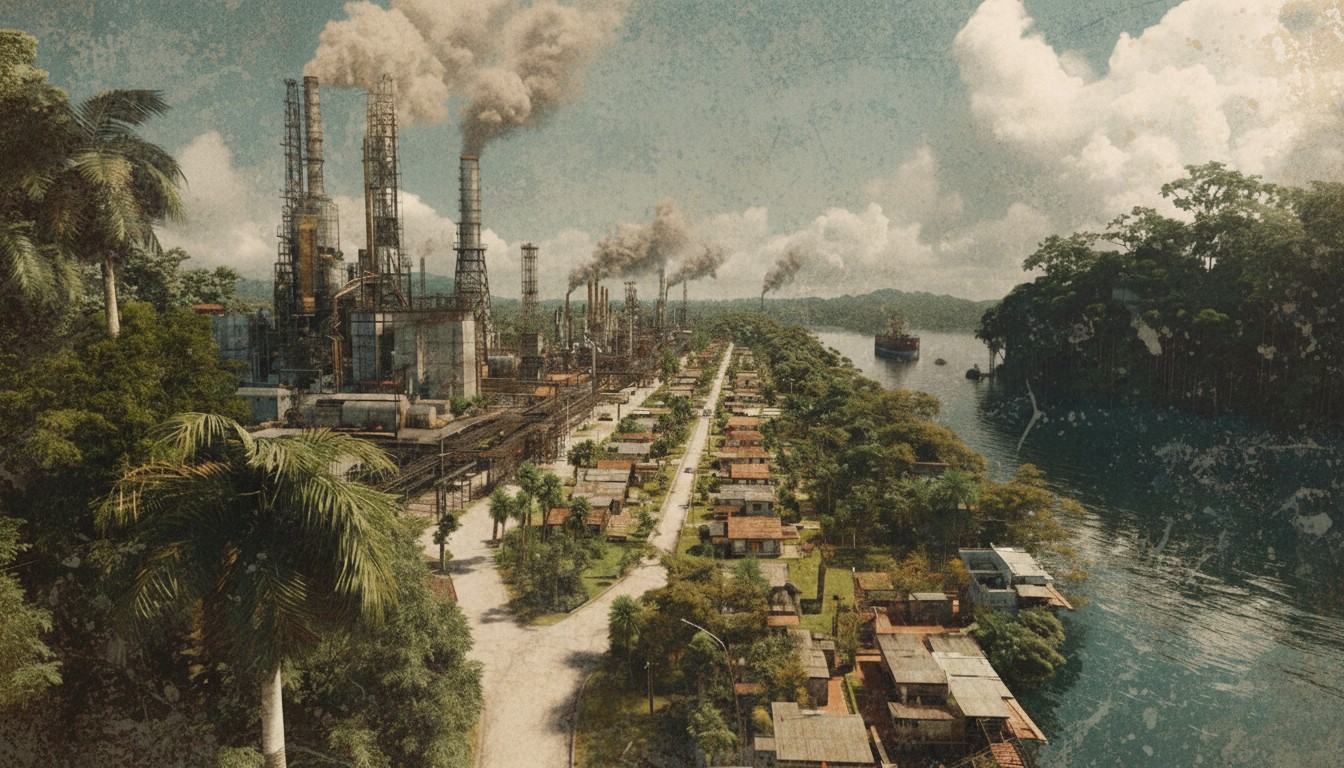
In 1928, Henry Ford carved a Midwestern town out of the Brazilian jungle. Across 10,000 square kilometres of Pará rainforest, hardwood stands were felled and hills levelled; in their place rose a prefabricated company town: Fordlândia. Tight rows of rubber trees marched up the slopes, flanked by cavernous warehouses, a sawmill and water towers, and bungalows laid out like a Michigan suburb.
The plan was simple: grow rubber at industrial scale, feed Detroit’s tyre lines, and bypass British Malaya. Ford’s genius lay in standardisation. But his template could not be applied to the Amazonian terrain. Dense plantings succumbed to leaf blight, soils leached, pests thrived, and imported work rules sparked unrest. By 1934, the city lay abandoned.
Fordlândia is just one effort amongst many to apply foreign blueprints for success in Brazil. In this week’s edition of Zola’s Chartbook, we trace the long history of failed attempts to escape the middle-income trap.
From Commodities to State Capitalism
In the early 1900s, coffee dominated Brazil’s economy and politics. Despite the impact of the 1888 abolition of slavery on labour supply of the coffee plantations, rapid growth in global demand for the drink drove a monumental wave of immigration into Brazil. Between 1884 and 1914, over 2.7 million immigrants arrived in Brazil, with the majority going to work on coffee plantations in São Paulo. By 1900, two-thirds of export revenues came from beans; railways, ports and customs houses were financed to move sacks to ships. Political power rested on the café-com-leite alliance of São Paulo coffee barons and Minas Gerais cattle interests. Brazil’s role as an agricultural powerhouse on the global periphery served this elite well, but left much of the country excluded and proved ultimately to be fragile.
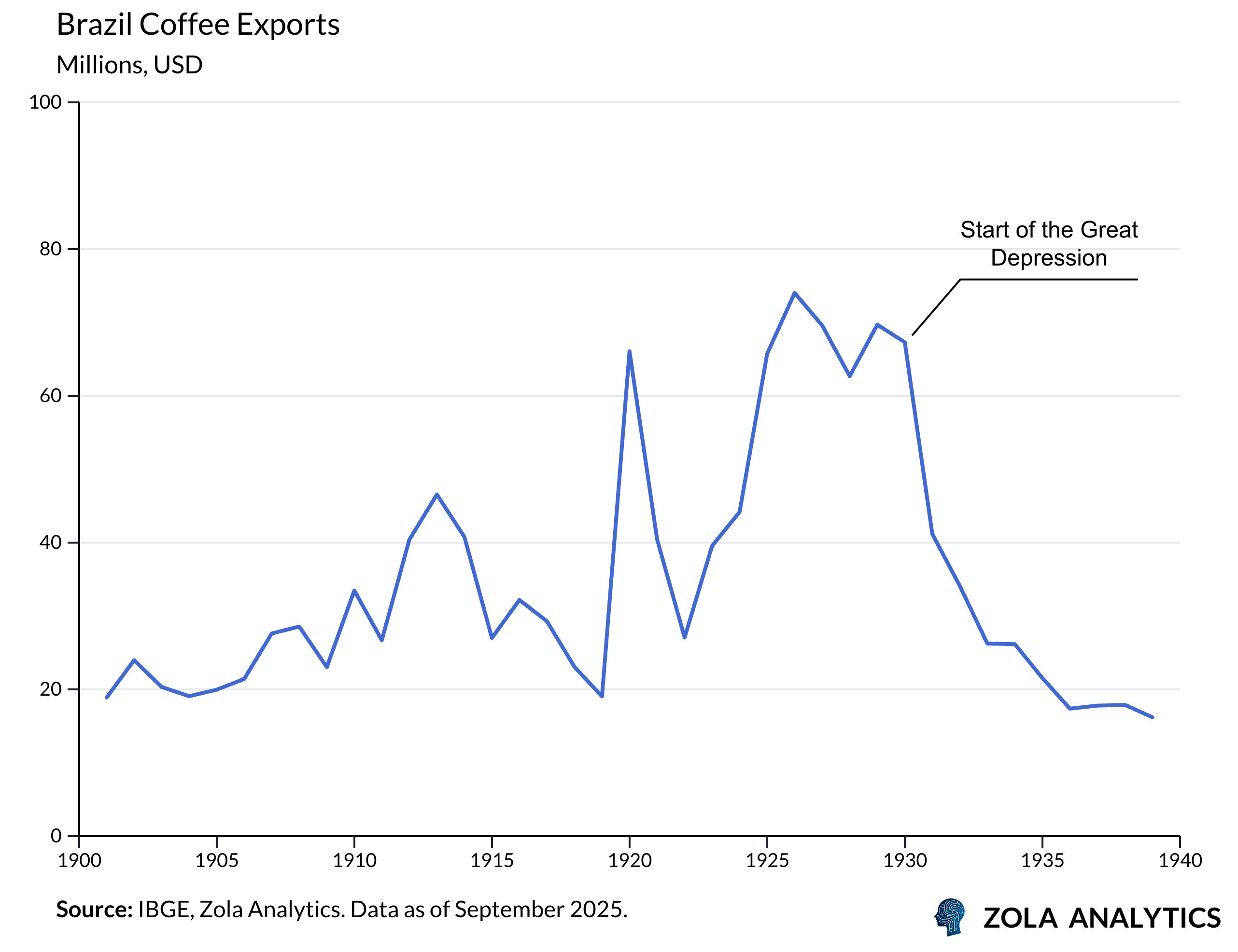
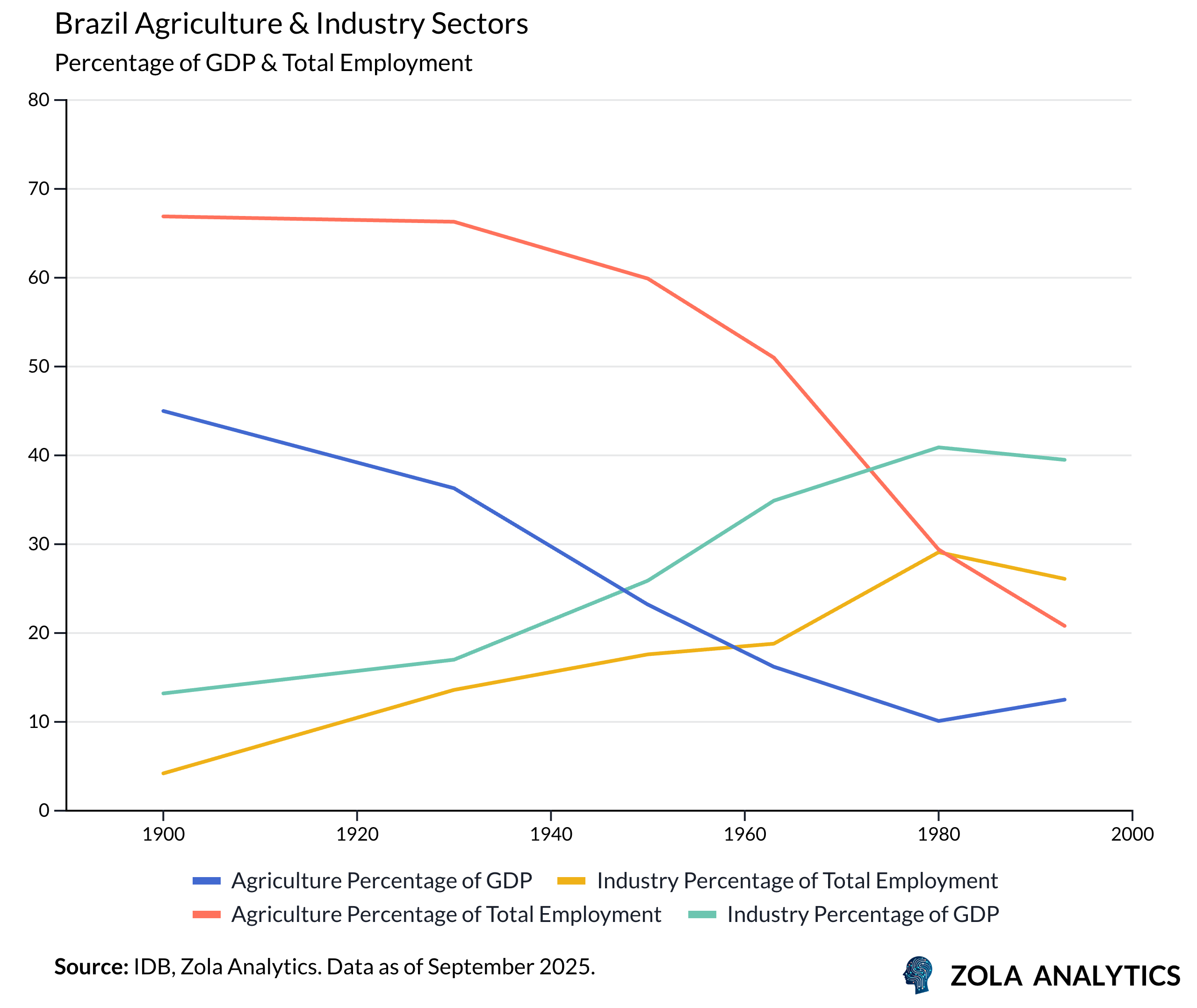
The Great Depression hit Brazil hard. Collapsing prices destroyed export receipts and fiscal capacity. Getúlio Vargas, taking power in 1930, pivoted inward: tariffs and exchange controls to insulate producers; corporatist labour rules to organise the workforce; new state firms in steel, energy, and mining. Wartime scarcity made imports rare and planning habitual, entrenching controls that outlived the conflict. Industry took root - but in small, protected home markets, not in rivalry with the world.
Fifty Years of Progress in Five
The 1950s marked a new phase of ambition. Following Juscelino Kubitschek’s election in 1956, the Plano de Metas was announced. Automakers were courted with licensing and local-content rules; grids and highways expanded; Brasília rose on the plateau. The model scaled fast thanks to protection, cheap credit, and a managed exchange rate. Effective protection was highest on final goods and lower on intermediates, creating high effective rates of protection and a built-in anti-export bias.
Import substitution was the orthodoxy of the age. Apostles from the United Nations ECLAC descended on Latin America to preach its truth. Its intention is to produce development and self-sufficiency through the creation of an internal market. After the military took over in 1964, they doubled down on the strategy.
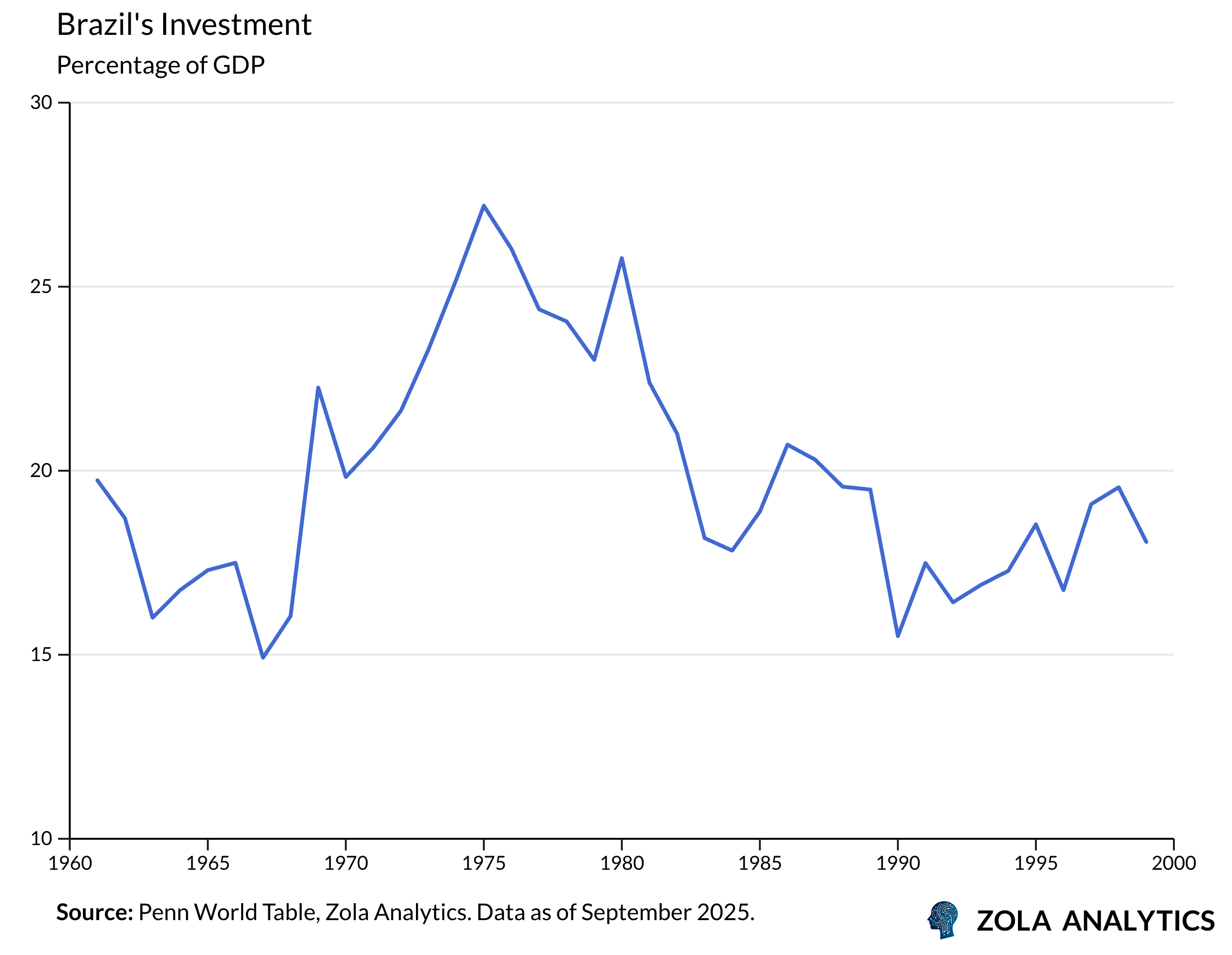
The Brazilian Miracle
But as the decade progressed, the inherent costs of the policy became apparent. High protection on final goods and controls on imported inputs pushed firms into short runs for a captive market. Plants ran below efficient scale, costs stayed high, and few suppliers reached world standards; learning-by-exporting never took hold. Because capital goods were largely imported, each investment surge widened the foreign-exchange gap and forced stop–go cycles when reserves tightened.
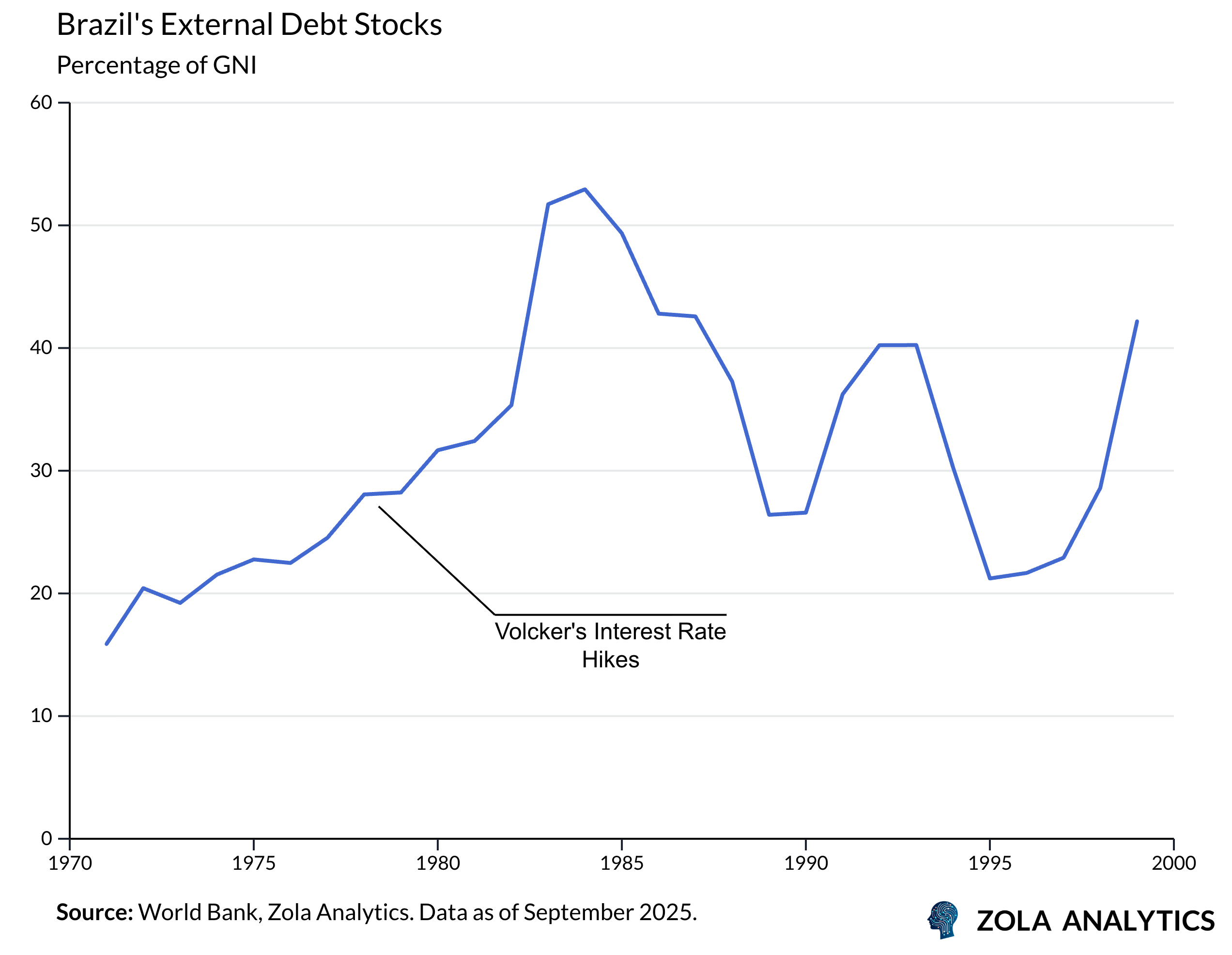
External debt rose from ~14% of GNI in 1970 to ~53% by 1984. When the Federal Reserve under Volcker tightened monetary policy, the bill arrived and Brazil’s economy entered a lost decade.
Across the Pacific
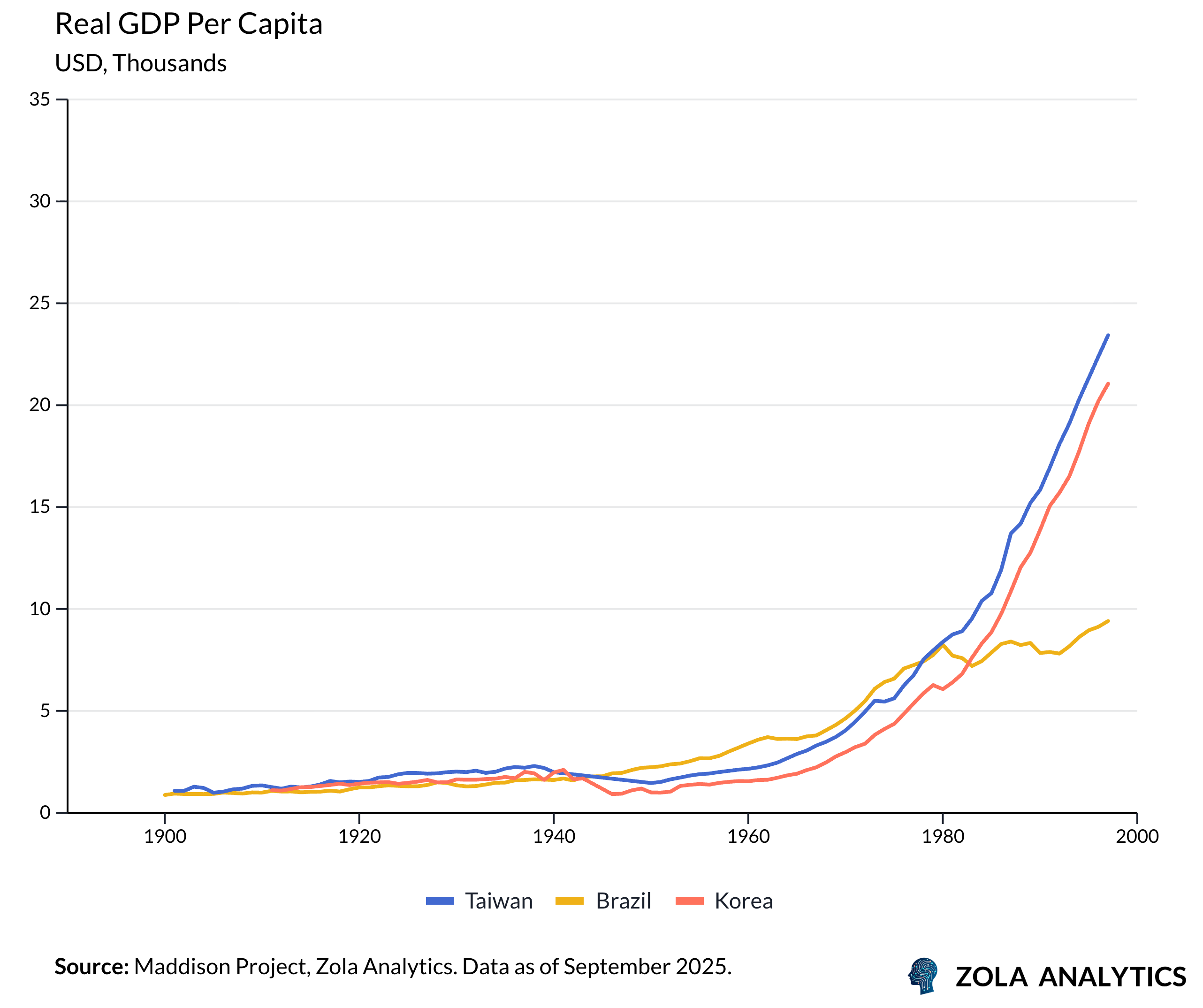
Just as Brazil’s miracle was coming to an end, East Asia’s export-led expansion was hitting its stride. Their experience showed that industrial policy could work, so why would it not work in Brazil?
Korea and Taiwan started with favourable conditions - broad basic education and low wages relative to skills - then kept unit labour costs in check while productivity rose. Authoritarian governments systematically repressed labor rights to favor capital accumulation and export competitiveness.
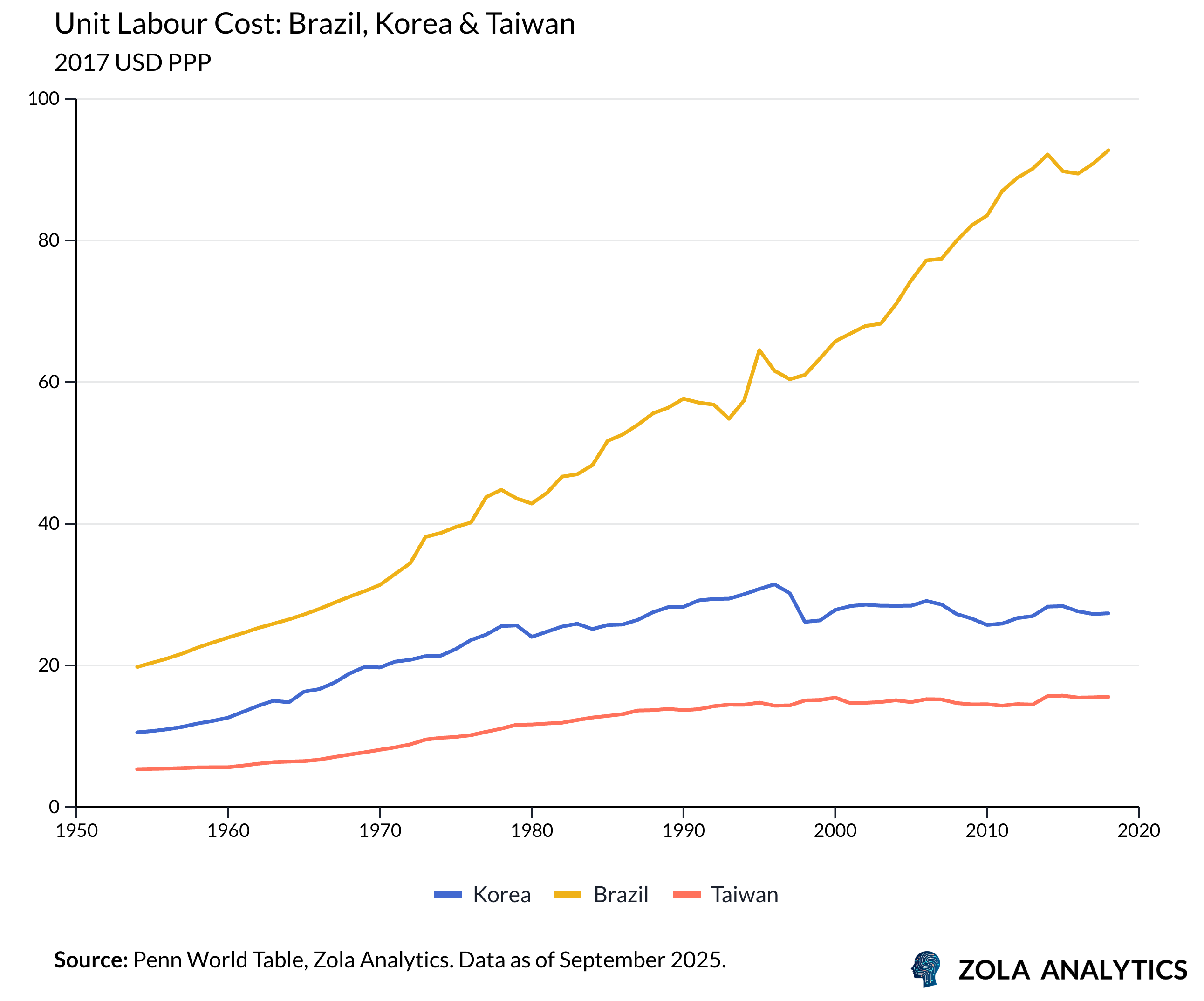
Brazil could never copy that template. It began with wages high relative to human capital and built politics around urban labour coalitions that could not legitimise sustained wage restraint. Without the political power to repress wages and consumption, the push for industrialisation is doomed to fail.
Stable or Stagnant
The military regime was discredited by the economic disaster of the early 1980s and fell in 1985. This was followed by a period of hyperinflation driven by debt overhang, pervasive indexation and fiscal dominance. Through the 1990s Brazil adopted Washington Consensus policies - trade opening, privatisation and FDI openness, fiscal consolidation and price stabilisation - culminating in a 1999 float and inflation targeting.
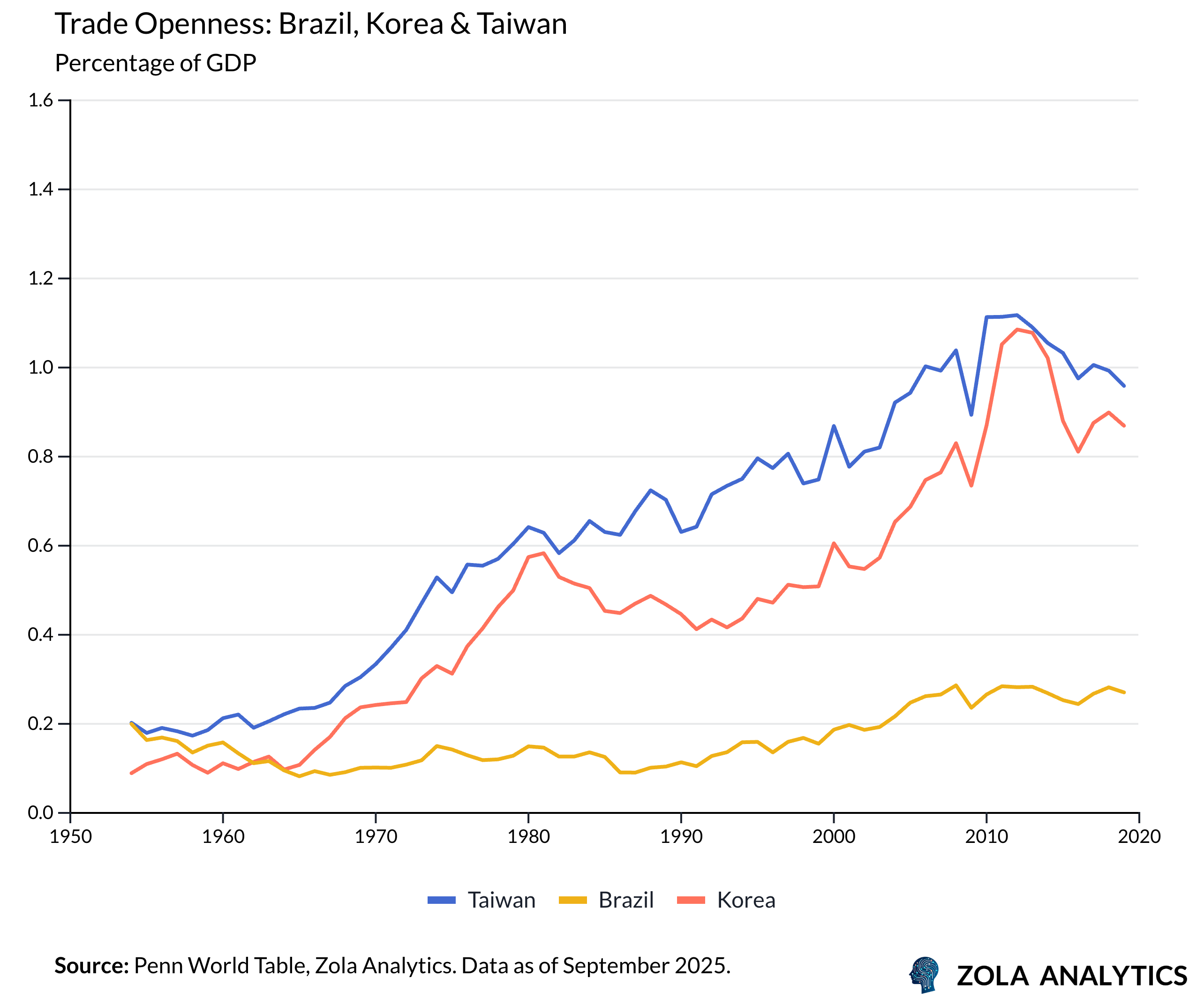
This brought much-needed stability, but the framework was imported without adaptation to Brazil’s constraints: real rates stayed high; capital inflows kept the real strong, squeezing tradableS and hastening premature deindustrialisation; logistics and taxes weighed on competitiveness; and the profit centre remained the home market.
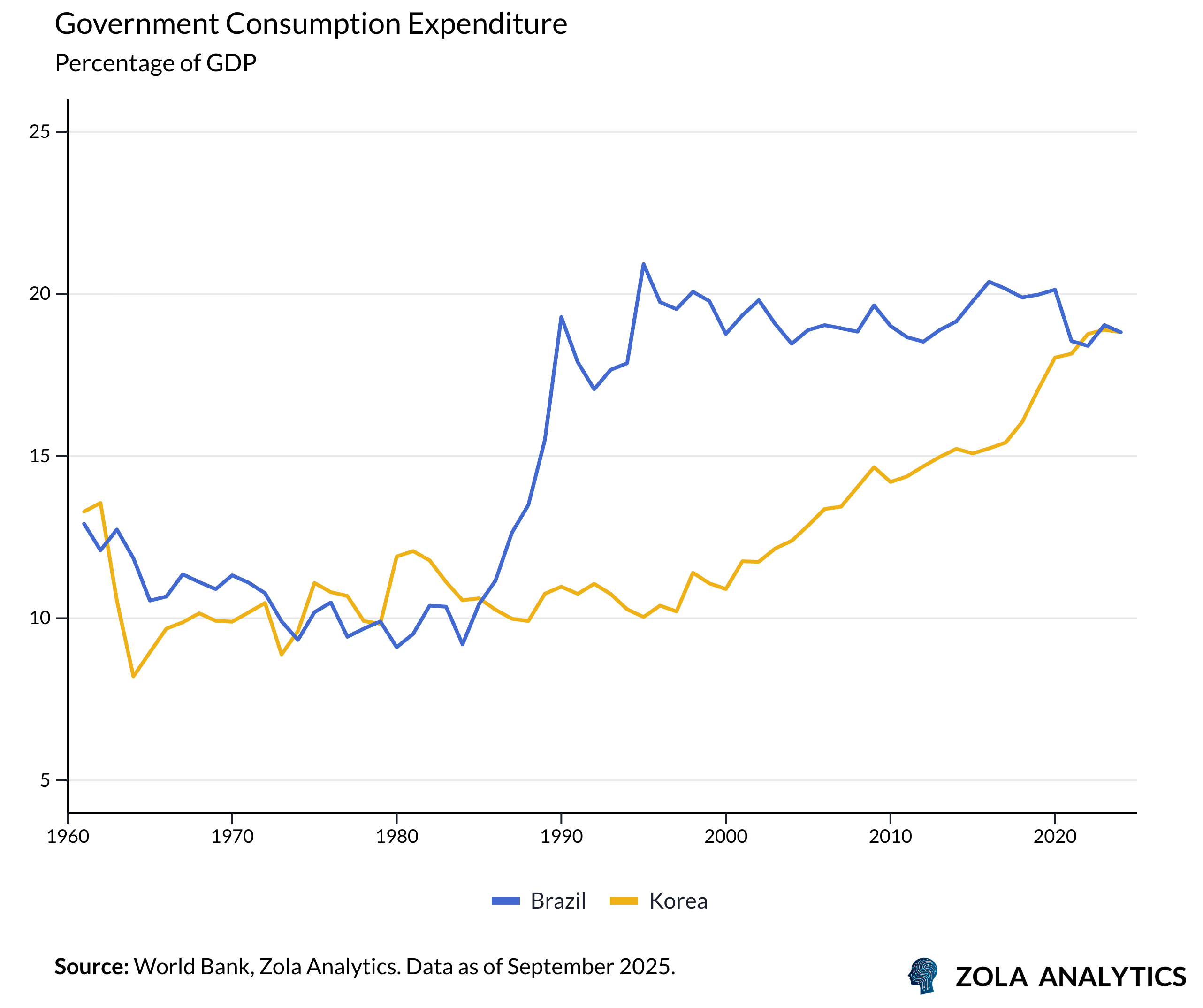
Privatisation shifted infrastructure to private finance that struggled with long-horizon risk. Fiscal rules restored credibility yet locked in current spending, crowding out investment. The reforms that stabilised prices also embedded constraints that later resurfaced.
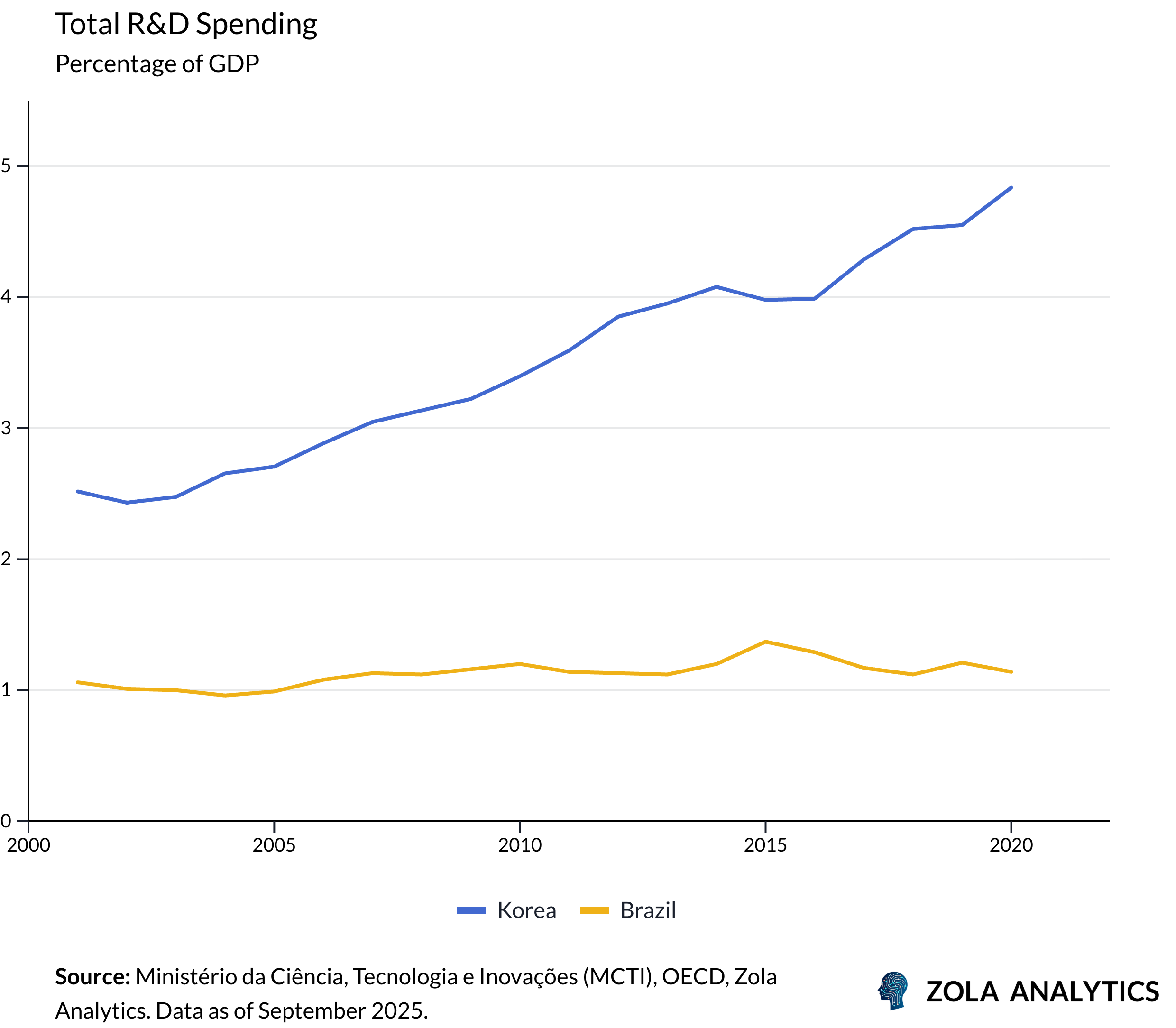
Innovation policy matured in the late 1990s - sectoral funds, Lei do Bem, state foundations -and the commodity boom gave it lift. But headline R&D stayed near 1.2% of GDP and business near 0.6%, less than half the OECD average. High levels of protection continued to stifle the diffusion of innovation. Where firms did face world-class rivals, such as Embraer, Natura, WEG, and Suzano, they upgraded and innovated. The larger mass, serving protected domestic markets, did not.
Redistribution on a Narrow Base
The 2000s commodity boom expanded fiscal space. China used its windfall to build ports, grids, and manufacturing capacity; Brazil prioritised incomes. Bolsa Família scaled, the minimum wage rose in real terms, and millions entered the middle class. Poverty fell; inequality narrowed. Demographics helped: a larger working-age share lowered dependency and made transfers easier to finance.
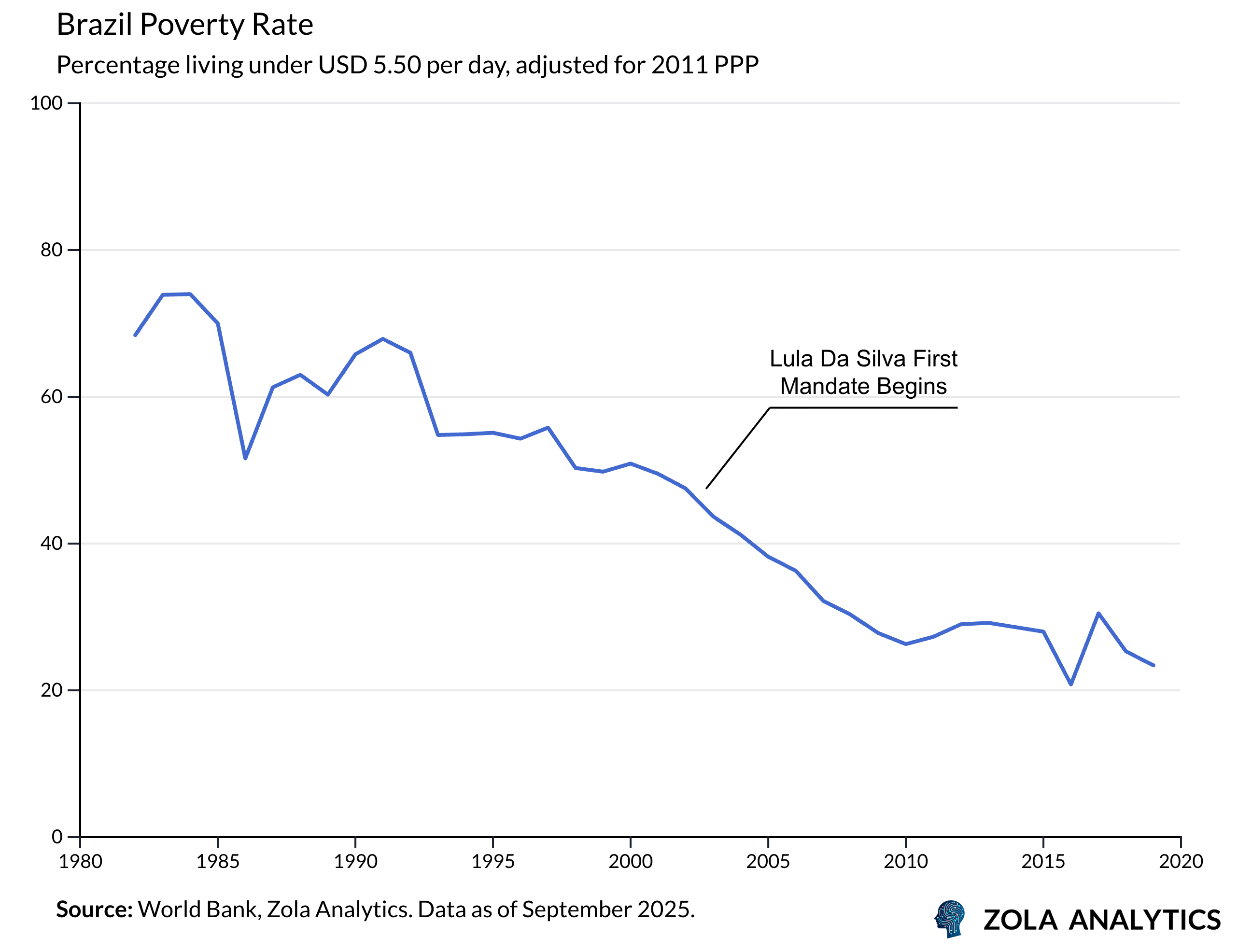
But the economy’s productive base remained narrow. Productivity was flat through the boom, and when prices turned after 2011 the response - subsidised credit, tax breaks, and administered prices - deepened distortions. With capital goods imported and exposure weak, the surge in demand outpaced capability. By 2015–16, recession arrived.
No Easy Answers
Brazil’s constraint today is not weak demand but the price of capital and slow productivity growth. At home, the real cost of capital sits above potential growth, keeping debt dynamics tight unless primary balances over-perform. Households devote a large share of income to debt service, damping consumption. Potential growth is sub-2%, and the demographic tailwind has faded.
Since 1980 Brazil has hovered near ~28% of US income per head.There is no easy blueprint that can be copied to close this gap. Protection explains part of the shortfall, but East Asia’s export-driven labour-repression model is not available, or desirable, in a Latin American democracy.
Nonetheless, a workable path exists:
Make public credit and procurement conditional and temporary: offer subsidised loans or contracts only once a firm has proved foreign demand or hit clear supplier-upgrade milestones and end support after a fixed sunset unless targets are met.
Open sheltered markets to real competition: default to open, multi-bid tenders and publish any exceptions.
Use Brazil’s renewables, biomass and minerals to produce exportable goods and services with durable cost advantages - long-tenor power that shows up in delivered prices, mid-stream processing, and tradable services tied to those value chains.
On the macro side, lower borrowing costs by committing to a credible primary-balance path and better debt management.
On the supply side, cut the costs between factory and buyer—freight, ports, paperwork and tax complexity - so firms can reach scale and compete abroad.
It will take some imagination. As Alexander Gerschenkron noted: “There is a deep-seated yearning in social science to discover one general approach, one general law valid for all time and all climes. But these primitive attitudes must be outgrown.”
Sign up to receive the Zola Global Macro Chartbook every week: https://www.zolaanalytics.com/insights?signUp