
More abroad, less invested at home

More abroad, less invested at home
Two decades ago, Germany's "Bazaar economy" debate questioned whether its export success was masking a gradual relocation of production abroad. Today, a related question is emerging: are German companies increasingly earning abroad while investing less at home?
Germany's labour share is approaching a record 59% of national income. That might look like good news for workers. But alongside it, domestic corporate profit margins have hit a record low, net investment has almost stalled and profits earned abroad account for an increasing share of corporate income.

A record squeeze, not labour hoarding
The net operating surplus of German non-financial companies, the profit they make from domestic operations after depreciation, fell to 9.6% of GDP in 2025 Q3. That is the lowest since the series began in 1999, below the troughs of both the 2009 crisis and Covid. In 2007, it was 15.8%.
No other large euro-area economy is as close to its historical low. Germany's current reading ranks seventh lowest of 107 quarters, against 30th for Spain and 53rd for Italy.

The obvious explanation is labour hoarding: firms retaining workers through a stagnant economy, allowing wages to take a larger share of a flat pie. But since 2019 Q4, German output per worker has grown by 1.5%, more than in France or Spain and broadly in line with Italy.
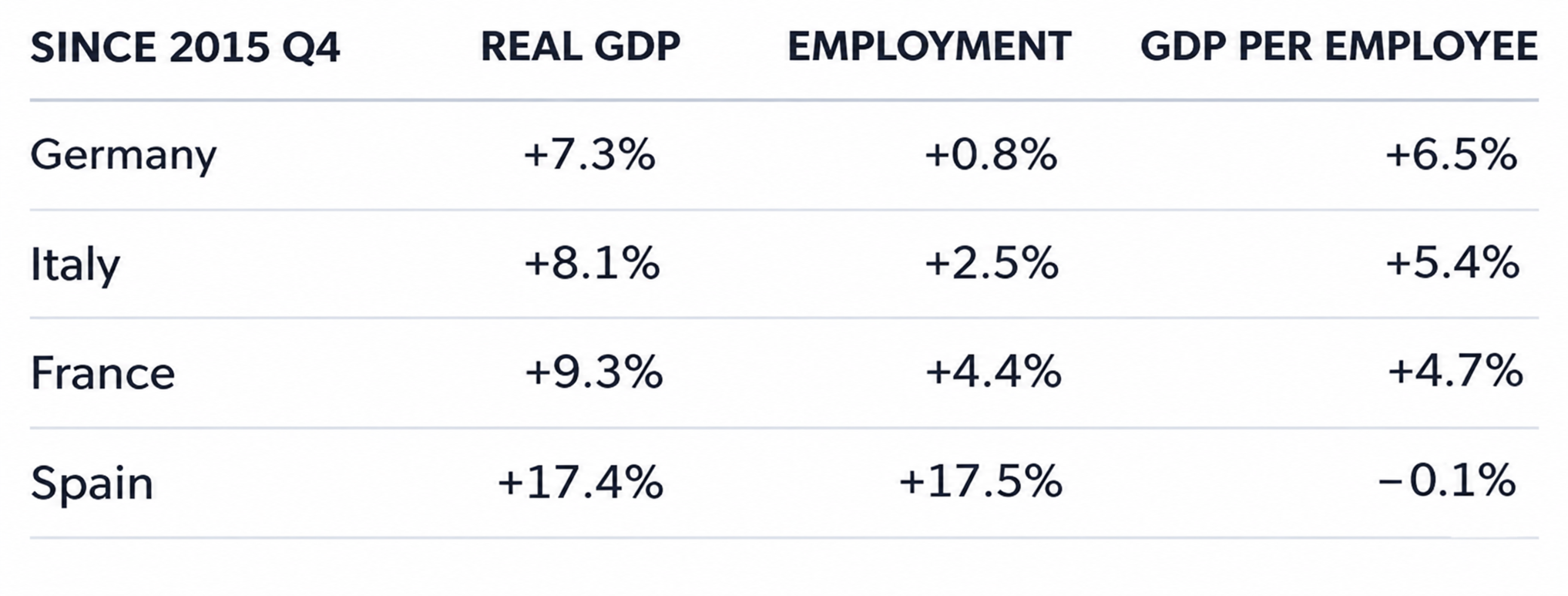
The squeeze instead points to weaker pricing power, with pay rising faster than the prices companies can charge. Energy costs and Chinese competition are possible contributors, although the data cannot establish their relative importance.
German companies have almost stopped investing at home
The weakness in profitability is accompanied by an equally striking investment picture.
Net investment by German non-financial companies, investment minus the capital that wears out, has fallen to just 0.1% of gross value added, against 3.5% in 2007 and 3.2% in 2019. Elsewhere, it remains considerably higher: 6.0% in Italy, 5.4% in Spain and 3.0% in France.

There are signs of a cyclical recovery. Manufacturing has returned to growth, new orders have improved and fiscal stimulus is supporting domestic demand. But turning a rebound in activity into lasting growth will require stronger private investment and productivity, just as an ageing workforce is tightening the supply of labour.
More profits abroad, with China increasingly important
While domestic margins and investment have weakened, German companies have become increasingly reliant on income generated overseas.
In 2007, net profits from abroad accounted for 7% of German corporate profits. Today, they represent 19%. Over the same period, the US share fell from 20% to 12%. German companies now derive a larger share of their corporate profits from abroad than their American counterparts.

China is an increasingly important source of this income. In 2024, German firms received €17.3bn in direct investment income from China, or 13% of the total, almost twice the €8.9bn from the US. The Netherlands and Luxembourg rank higher, but largely reflect holding-company hubs through which income passes.
China's importance extends to manufacturing investment. It accounted for 13.3% of German manufacturing FDI stocks abroad in 2024, almost twice its share in 2010.

This outward expansion may increasingly come at the expense of investment at home. The ECB's 2026 research finds a long-run substitution relationship between outward FDI and domestic investment in Germany. IW's latest company research points to a similar shift in companies' investment intentions.
Neither study establishes which development came first. But together they suggest that the relationship between foreign expansion and domestic investment is changing.
Two decades ago, the "Bazaar economy" debate asked how much domestic value Germany retained in its exports. Today, the question is where the next generation of its productive capacity will be built.
Comments
No comments yet. Be the first to share your thoughts!