
The tax rise nobody voted for
The tax rise nobody voted for
Spain lets inflation raise its income tax, and gives little back
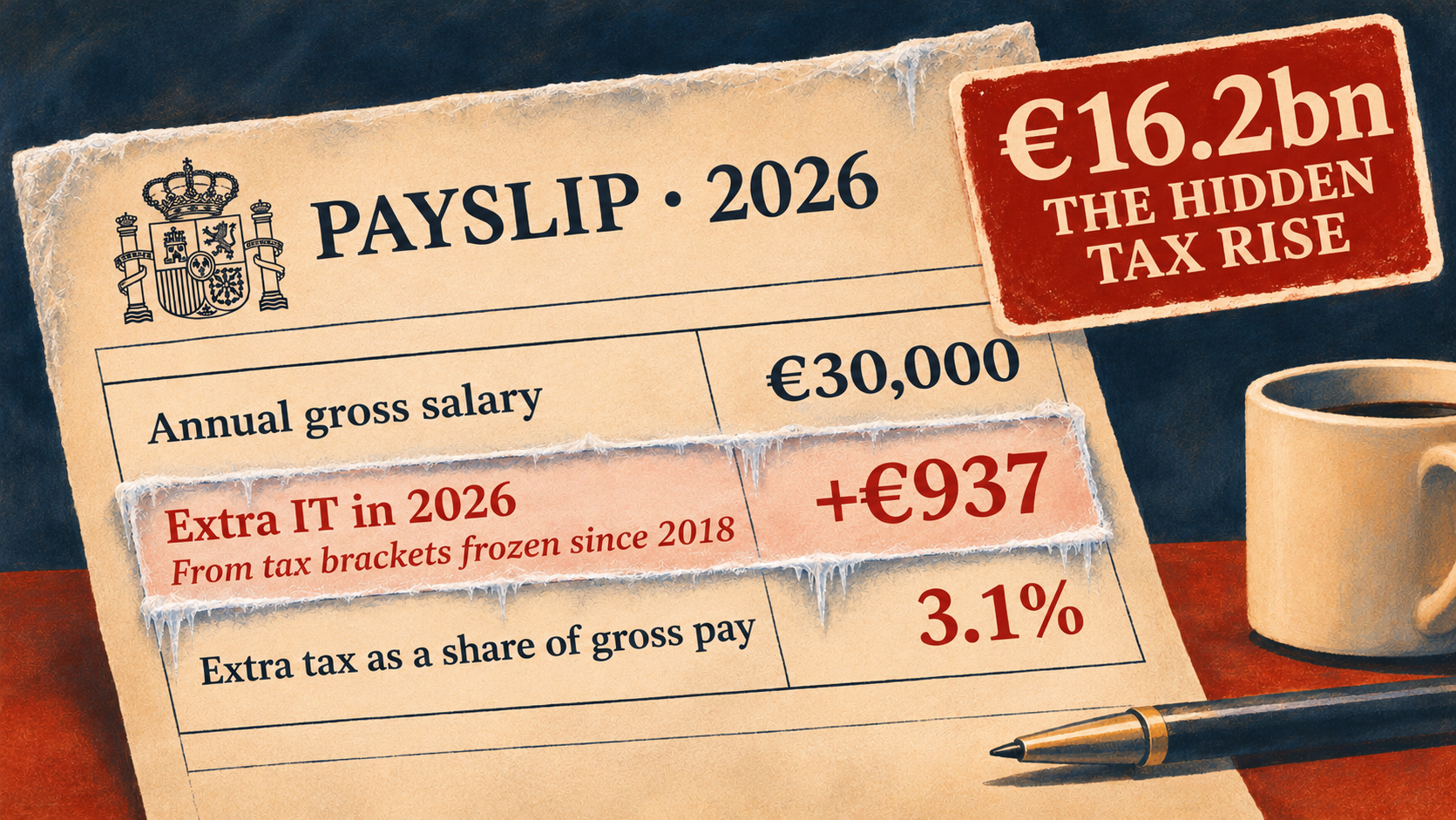
This week the Instituto Juan de Mariana, a free-market think tank, put a number on a tax rise that never went through Parliament. Because Spain has not updated its income tax (IRPF) for inflation, taxpayers will pay an estimated €16.2 billion more in 2026 than under indexed rules. That is close to 0.9% of GDP, and €55.6 billion in total since 2019. Congress has passed non-binding motions urging indexation, as recently as April 2026, but no law has changed the bands. The general election is on 29 November.
Consumer prices rose 29.5% between July 2018 and October 2026, but the tax bands and allowances have not moved. A pay rise that merely keeps up with inflation pushes income into higher bands, so the tax bill grows even when purchasing power does not, which is what economists call fiscal drag. The personal allowance is still €5,550, the figure set in 2015. Indexed since then, it would be about €7,300.

This is a counterfactual rather than a bill from the tax office. The government’s own estimate in its Annual Progress Report to Brussels is narrower, at €2.3 billion of extra revenue in 2025, because it counts only that year’s freeze rather than every year since 2018. Even so, the government itself books non-indexation as revenue.

A single earner on €30,000 pays €937 more this year, about €78 a month. From €25,000 up, families pay more again, because child allowances have not changed since 2015 either.

The government argues that full indexation would give most back to higher earners. In euros it would, but as a share of pay the loss is largest for a single earner on €20,000, close to 5%.
Spain is in a small group. From 2021 to 2025 prices rose 15–28% across eight large European economies. Germany, France and Belgium moved their brackets almost in line, and Austria and the Netherlands moved theirs most of the way. Spain and the UK did not move them at all, and Italy changed its bands through reform rather than indexation.

Those three now raise similar sums from the freeze. Britain takes about 0.95% of GDP this year, Spain about the same and Italy about 0.8%.

What separates Italy from Spain is what happened to the money. Italy never indexed either. But the Bank of Italy counts €31 billion of tax, contribution and benefit changes in 2022–25. That is more than the €20 billion that drag and benefit erosion took.
We used the same method for seven countries. Spain gave back the least, about a quarter. Even the top of its range is below every other country's lowest estimate.
Britain is the surprise. It froze its bands too, but National Insurance cuts returned most of the money.

The chart also tests the government's answer, that it returns the money in other ways. Adding contributions and benefits lifts Spain's share by only five points. Household by household, the money comes back only to families who ask. A child supplement worth €1,656 a year more than covers the extra tax of a one-earner family with two children on €30,000. But a family must apply for it through the minimum income scheme, and AIReF estimates that 71% of eligible households never do. A single earner on €30,000 or €60,000 gets nothing back.


Drag is not the whole story of Spain’s tax boom, though. IRPF revenue rose €13.1 billion in 2025, to €142.5 billion, and AIReF puts that year’s new drag at about €1.8 billion, using a different method from the government’s. Most of the rise came from more people in work and higher nominal pay, which is the healthy kind of revenue growth.

The next government inherits a tax rise that grows every month the brackets stay put. Inflation reached 4.9% in October, so 2027 will cost taxpayers more than 2026.
The Partido Popular promises to index the brackets, which the institute costs at about €16 billion a year from 2027, roughly 1% of GDP. Vox promises deeper income-tax cuts. The PSOE proposes a progressive deduction linked to prices instead, and the Frente Amplio, which now includes Sumar, does not propose indexation.
Whichever of these wins on 29 November, doing nothing keeps the freeze in place without a single vote. Spain has not passed a budget since 2023. A tax rise worth €16 billion a year belongs in one that Parliament votes on, like any other.
Comments